

Learning Objectives:
- Students will: consider the Roman Catholic process of electing a new pope through the process of the conclave.
- Examine a biblical view of leadership and guidance.
- Reflect on how prayer and discernment sit alongside personal ambition.
Learning Outcomes:
- Consider how different leaders are chosen in society and reflect on the characteristics of good leadership.
- Analyse Jesus’ teaching on leadership, and a number of Bible passages on guidance in order to understand how prayer can help decision-making.
- Consolidate learning by using the biblical teaching to create a job description for a youth work leadership position.
Supporting Values Education:
- The values of Democracy and Rule of Law are based on a shared community where people feel that they belong. The societal understanding of these values means that leadership is valued and held to account. This lesson helps students consider what constitutes good leadership in a democracy. The value of Religious Liberty means that religious communities have freedom to express their belief in the value of prayerful discernment.
STARTER:
Give each student a copy of the Choose The Leader worksheet.
Begin by asking students to connect the roles to the descriptions by drawing a line to the correct description of how the posts are appointed. You may need to explain some of the roles and the processes!
The correct answers are:
| King | Decided by descent (being in a particular family), religion (must be in communion with the Church of England) and primogeniture (firstborn child). Previously, younger male heirs displaced their older sisters. This was abolished in 2013. |
| President of the USA | Elected indirectly through the Electoral College to a four-year term, along with the vice president. The Electoral College is made up of representatives of each US state. No person who has been elected to two presidential terms may be elected to a third. |
| Headteacher | (Typically) Through a job advert, a selection process, and interview by the governing authority (local council, school governors, school board etc.) |
| Prime Minister | The leader of the winning political party at a general election who is then invited by the Monarch to form a government. |
| Pope | Through a process known as a conclave where all cardinals under the age of 80 vote for the person they think most suitable. |
| Poet Laureate | Appointed by the Monarch acting on the advice of the government, helped by a steering committee including representatives from a range of literary and arts organisations. |
| Chief Scout | Appointed by the member’s council (now the Board of Trustees) for a five year term which is made up of members elevated by the association. |
The second part of the worksheet involves selecting three words and then articulating why the words describe a good leader. Once the class has finished the worksheet, have a conversation about the characteristics of good leadership.
Does the class agree on the characteristics of good leadership?
Do the characteristics change depending on the type of leadership role? For example, is a good religious leader different to a good political leader?
What examples of good leadership can the class think of? Can they think of some examples of bad leaders in history?
Can anyone suggest a leader who was reluctant to lead?
Explain that in today’s lesson you are going to be learning about how Christians view leadership, ambition and decision-making.
MAIN ACTIVITIES:
Introduce the film clip by explaining the following:
In the Roman Catholic Church, the global leader of the church is the Pope. The Pope, the leader of around 1.4 billion members, is chosen by a process known as a conclave. Within the Church, there are leaders called cardinals, and the Pope is chosen from amongst the cardinals. During a conclave the cardinals are sequestered, which means they have no contact with the outside world. They vote using ballot papers, and once the ballot papers are checked, they are threaded onto a long piece of string and burned. To become Pope, a cardinal must obtain two-thirds of the vote. Until that happens, the cardinals must keep voting at regular intervals, and each time a vote is concluded the result is communicated to the outside world by sending up a column of coloured smoke – black for ‘no Pope’ and white for ‘Pope’.
See https://www.bbc.co.uk/newsround/articles/cp8j0gwe12ro for a helpful infographic explanation of the process.
This is an ancient process, but is still used by the cardinals to choose the Pope from amongst their group. The cardinals are expected to take the responsibility seriously and prayerfully, asking God to show them who the next Pope should be.
Ask the class to look out for the particular voting traditions as they watch the clip from the film, Conclave, which is a fictional account of a conclave.
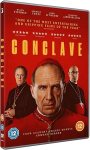
Show the clip from Conclave (Indian Paintbrush/Black Bear 2025, certificate 12). Click here to buy the DVD online.
- Start time: 00.43.29
- End time: 00.51.46
- Clip length: 8 minutes 17 seconds
The clip begins with the announcement of the first round of voting in the conclave to elect a new Pope. Cardinal Lawrence (Ralph Fiennes) announces to the gathered cardinals that the first ballots concluded and, given that no-one met the necessary majority of 72 votes, the cardinals are dismissed for the night. As he speaks we see the process of the voting papers being burned and the black smoke canister being lit. The smoke goes up and the crowd’s cheers turn to disappointment. As he leaves the chapel, Lawrence is briefed by his aide O’Malley (Brían F. O’Byrne) about Cardinal Benitez (Carlos Diehz) a newcomer who has turned up unexpectedly at the conclave. He also speaks to him about rumours he has heard about one of the strong candidates, Cardinal Tremblay. Lawrence gets onto the coach back to the lodgings, assuring another cardinal that he has no ambition to be Pope. Later, he comes across Benitez looking at the late Pope’s turtles. Benitez tells him he voted for him. Lawrence tells him he is not a serious candidate, and that he hopes to resign as dean and leave Rome. He confesses that he has been experiencing difficulties with prayer. Later Lawrence comes across his friend, Cardinal Bellini (Stanley Tucci). He tells him he feels wretched that his votes have taken support from Bellini. Bellini replies that he had no idea that he (Lawrence) was so ambitious. He goes on to talk to him about two of the other candidates – Tedesco and Adeyemi – and tells him he has to pick a side. Lawrence tells him it’s not a war. Lawrence says that Bellini can’t seriously believe that he wants to be Pope, and Bellini replies again that he didn’t know Lawrence was so ambitious, and that every cardinal wants to be Pope. The scene ends with Lawrence in his room, sitting on his bed, trying to pray.
Discuss the clip with the students. Did some of the conversations surprise them? What did they think about Cardinal Lawrence? Would he make a good Pope? What about Cardinal Bellini? Why was there so much intrigue and quiet conversation happening throughout?
Did they believe Lawrence when he said he had no ambition to be Pope? What did they think about what Bellini said about every cardinal secretly wanting to be Pope?
Cardinal Lawrence had the difficult job of overseeing the process of selecting the next Pope, but he confessed to Cardinal Benitez that he is finding it hard to pray. He was dealing with the competing ambitions of different individuals and groups of cardinals.
The purpose of the conclave was for the cardinals to pray and to listen to God about the next Pope. They want to make the right choice, but many of them are ambitious to be the Pope. Meanwhile, not being able to pray was making it difficult for Lawrence.
Distribute the Ambitious To Lead worksheet and in pairs ask the class to discuss the positive and negative aspects of leadership. You could ask one partner to list all the positives and the other to list the negatives. There is one example of each on the worksheet to get them started.
When the first part of the sheet is complete, display the following quote (also on the worksheet) and ask the class what they think it means:
“He who does not desire power is fit to hold it.”
Plato
Often being too ambitious to lead doesn’t make a person a great leader. Sometimes those who are more reluctant to lead make the best leaders.
Explain that being the Pope is a particular type of leadership. Leading within the church means following Jesus Christ’s example of leadership.
Ask the class to complete the rest of the handout by reading the Bible passage (Mark 9:33-37) and describing leadership from Jesus’ point of view.
Once the class has completed the task, ask for some volunteers to read their final answer, and compile a list of characteristics Jesus looks for in a leader.
Watch the following video from The Bible Project:
https://bibleproject.com/videos/last-will-be-first
Distribute the Help When You Need It worksheet. Remind the class of the problems Cardinal Lawrence was having with prayer. The verses on the sheet might be useful to him. Ask them to match the verses with the idea they carry. Which of the verses do they think would be most useful to Cardinal Lawrence?
SUMMARY AND ASSESSMENT OF LEARNING:
Use the Job Advert worksheet to create an advert for a youth leader in a church. Students must use the characteristics of good leadership they found earlier, and the Bible verses they looked at, to write a job advert for a person to lead the youth work in a church. The advert should be about a paragraph long, and should include at least one idea from the Bible you’ve looked at in today’s lesson. If you have time, ask students to create a thirty second video clip to advertise the job.
YOU WILL NEED:
- A copy of Conclave. Click here to buy the DVD online.
- Copies of the Choose The Leader worksheet.
- Copies of the Ambitious to Lead worksheet.
- Copies of the Help When You Need It worksheet.
- Copies of the Job Advert worksheet.
- Links to Bible Gateway Last Will Be First video (https://bibleproject.com/videos/last-will-be-first).
- Links to Newsround information on Papal Conclave (https://www.bbc.co.uk/newsround/articles/cp8j0gwe12ro).
 Ethos Education